

Maxim Hoekmeijer Test
Beyond diagnostic boundaries
27 juni 2025
Protected: Maxim Hoekmeijer Test
Rijksuniversiteit Groningen
Open Ebook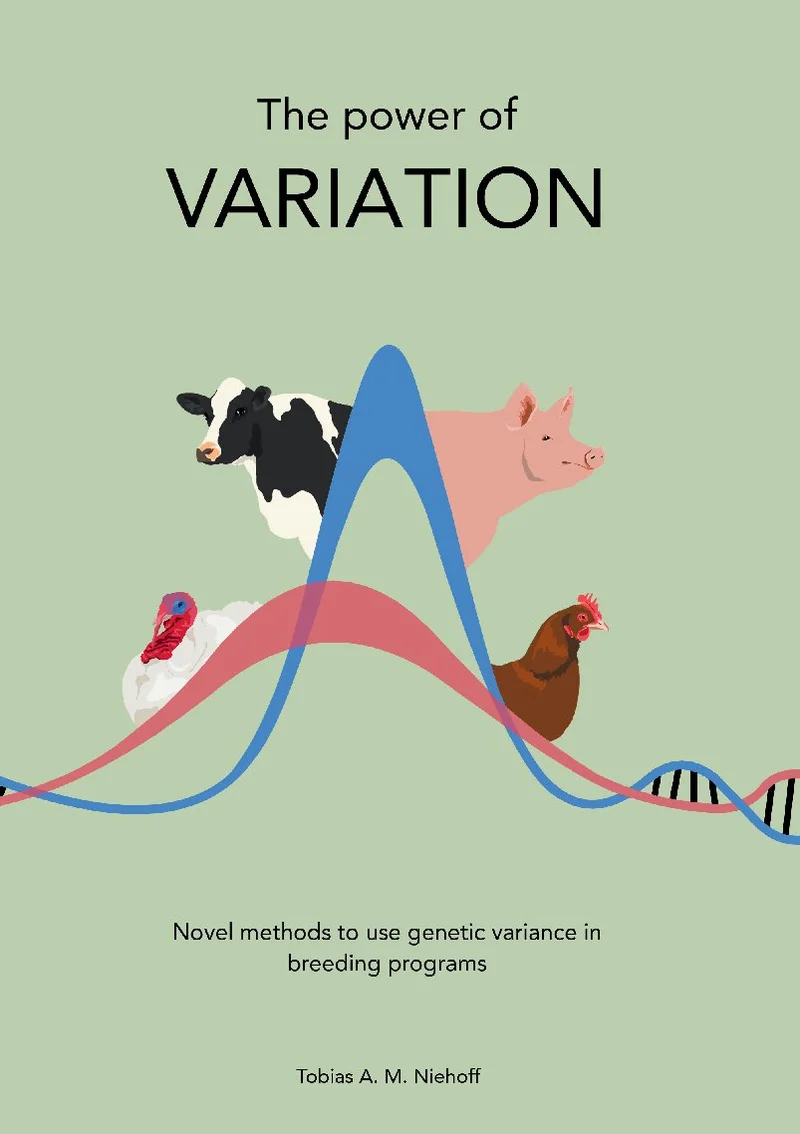
Share this project
Summary
The availability of genomic data is opening doors for new approaches to selection in animal breeding. This thesis develops and evaluates approaches that consider genetic variation in selection decisions with the ultimate goal to enhance genetic gain. The first three research chapters (Chapter 2, 3 and 4) of this thesis deal with the idea to predict the genetic variance, or variance of genomically estimated breeding values (GEBV), of offspring, grand-offspring and further distant descendants of selection candidates and to use these variances in selection criteria. These criteria improve the competitiveness and genetic diversity in breeding programs but are by design not focusing on long-term variance and thus long-term genetic gain. The last two research chapters (Chapter 5 and 6) developed concepts to restructure breeding programs to specifically integrate genetic variation that is relevant for long-term genetic gain. All evaluation in this thesis is theoretical or made by means of simulation.
Chapter 2 compares several previously proposed selection criteria that make use of predicted progeny variances in a simulated breeding program over multiple generations. In addition, two new criteria that not only consider progeny variance but also grand-progeny variance are developed and analyzed. These new criteria are referred to as “looking two generations ahead”. The concept of distinguishing between “conventional genetic level” as the population average breeding value, and “commercial genetic level” as the average breeding value of the animals that are sold to production farms or whose semen or progeny is sold to production farms, is introduced. This distinction is the foundation of the justification to not select animals with the highest BV, which maximizes conventional genetic gain, but to jointly consider an animal’s BV and variance of BV it is expected to create in its descendants. We show that criteria looking 1 generation ahead provide up to about 3% more genetic gain compared to selection based on breeding values. Selection criteria looking two generations ahead provide up to about 5% more genetic gain compared to selection based on breeding values. Simultaneously, criteria looking one generation ahead results in populations with about 10% higher genetic standard deviations than populations selected based on BV. Criteria looking 2 generations ahead result in up to 30% higher genetic standard deviations.
Since the results of Chapter 2 show that planning one generation ahead is better than selection based on BV, and planning two generations ahead is better than planning one generation ahead, we wondered if this pattern continues if a criterion would plan three, or four or five generations ahead. The design of such criteria could follow the pattern of criterion planning one or two generations ahead and we present such forward-planning criterion in Chapter 3. However, the main development of Chapter 3 are equations to predict the variance among doubled haploid lines from any number of founders. This variance is not useful for breeding but it can be decomposed into gametic Mendelian sampling variances (MSV), i.e., the variance of Mendelian sampling terms that are produced by a particular individual. These gametic MSVs of descendants in turn are useful for selection decisions and allow the application of further forward planning criteria.
Our method of predicting variances required the assumption that selection does not change allele frequencies and linkage disequilibrium. Since this assumption will clearly be violated in real life breeding programs, Chapter 3 also includes an analysis of the impact of violating the assumptions. Two species with different numbers of chromosomes were simulated (10 and 30, referred to as “corn” and “cattle”) to evaluate the effect of the number of independent loci. After four rounds of selecting the 5% best individuals, the predicted gametic MSV were overestimated by 27% and 21% and showed a correlation to the true gametic MSV of 0.51 and 0.71 for the corn and cattle genome, respectively. Despite the lower predictiveness of variances for corn when violating the assumptions, we show that genetic gain can be enhanced more for species with less chromosomes when selecting with our new selection criteria compared to selection based on BV.
Chapter 4 deals with the practicality and implementation of the developed selection criteria in breeding programs. We test all criteria as well as random selection and selection based on BV in a genomic selection pure line pig breeding program. A simple solution to handling the complementarity issue of the selection criteria (the merit of an animal does not only depend on the animal but also on its mate and offspring’s mate) is presented by borrowing concepts of selection based on general combining ability from hybrid breeding. Essentially, animals that on average across all possible mates have a good value are selected. We use different genomic prediction training population sizes in Chapter 4 to generalize our results to real life (current, current + last two, current + last five generations in the training population). We find up to 2% benefit on genetic gain depending on the planning horizon of the criterion and the genomic prediction accuracy. This is lower than observed in Chapter 2 which is the joint result of 1) the lower accuracy of BVs and predicted variances, 2) the lower selection intensity, and 3) the larger effective population size. As in Chapter 2, although less strong, we find benefits on genetic variance of up to 20% for the variance among BV of candidates and up to 2% for genic variance depending on the training population size and planning horizon. By evaluating different genetic-variance-metrics, it was found that four times the average gametic MSV is a good indicator of the Bulmer, or selection, unaffected genetic variance.
The accuracies of genomic prediction measured as the average correlation of estimated and true BV within full sib families where higher (0.50 – 0.67 in generation 1) than the accuracies of predicted gametic MSV (0.26 – 0.52). This is caused by selection candidates having own phenotype observations in the evaluation which benefits the accuracy of EBVs more than then of gametic MSV. This also explains the stronger shrinkage we found acting on gametic MSV than on EBVs.
Selection cannot act on genetic variation that is not present. The main improvement of genetic variance caused by MSV criteria is due to LD and not due to QTL frequencies. Real life breeding programs loose genetic diversity increasingly faster due to faster inbreeding caused by shorter generation intervals and progressively less companies with lines to consolidate. These two factors were the motivation to investigate if breeding programs can be restructured so that external genetic material can be integrated in Chapter 5. For this, we propose a layered approach that serves to test and learn about the introduced genetic variation before it is eventually integrated in the elite population. We tested different metrics to select “diversity donors” based on 1) carrying good beneficial haplotypes, 2) carrying haplotypes absent from the elite, and 3) having a low mean kinship to the elite. The effects in terms of genetic gain and diversity were very similar among the metrics because they all tend to select donors that are from the oldest available generations. The more resources spent on diversity introduction, the lower the genetic gain (up to 10% lower when reducing the elite size by 25%) but the higher the genetic variation in the elite population. The conversion efficiency of converting genetic diversity into genetic gain was enhanced in restructured breeding programs. Including lower performing and less related animals from the introduction-layers in the genomic prediction training population did not result in different genomic prediction accuracies, level or dispersion biases. At least that is for elite candidates in restructured breeding programs compared to elites from not restructured breeding programs that have a larger elite component. This is sown in Chapter 6. Accuracies (CorEBV, TBV) were however lower for diversity donors 10 generations removed from the elite candidates (~0.3 for donors, ~0.8 for elite candidates). EBVs of these old donors were also more overestimated (by up to 2.94 estimated genetic sd) and overdispersed (slope of the regression of TBV on EBVs of 0.57). These poorer prediction parameters were not observed for animals in the introduction layers with donors in their pedigree however. Overall, the results of Chapter 5 indicate that more effort should be spent on keeping diversity than on (re)introducing it.
Chapter 6 investigates the effects of assortative mating on genetic variance. The motivation was to enhance genetic variance to increase the commercial genetic level. This in turn is motivated by the fact that even with successful diversity introduction, short-term competitiveness is always reduced. Assortative mating can be used as a mitigation strategy. We show that assortative mating should only be used in combination with a diversity keeping strategy like optimum contribution selection, because the inbreeding rate is increased under truncation selection. This is caused by an increase of variance of genetic contributions of families to the group of selected candidates. To limit the negative side effects of assortative mating, we tested a “tuned assortative mating” strategy that only performs assortative mating to a necessary level. That is, the desired correlation of EBVs of mated sires and dams was lower than 1. We worked out equations that allow to predict the maximum possible correlation between TBV of sire and dam (CorTBV sire, TBV dam) when the correlation between their EBVs (CorEBV sire, EBV dam) is 1. This requires EBVs and reliabilities of EBVs. We found that even when genomic prediction accuracy is high (CorEBV, TBV>0.7), the maximum possible correlation between TBVs of males and females is only 0.45 in our simulation.
Assortative mating had a positive effect on the commercial genetic level in the short-term over random mating but this advantage diminished over generations (no advantage in generation 20). It also helped overcoming the reduced competitiveness of breeding programs spending resources on diversity introduction but never outcompeted standard breeding programs that did not invest in diversity introduction. This is somewhat surprising since we simulated that these standard breeding programs were run with a larger elite population size and additionally used optimum contribution selection and assortative mating.
Chapter 7 is the general discussion of the thesis, where I mainly reflect on the work related to gametic MSV and presents ideas and give directions for future work. Most importantly, I propose the idea to manage a population’s genetic variance directly by maximizing for the highest average gametic MSV value of offspring similar to how the inbreeding rate is managed by minimizing average kinship. Ideas are given for implementation in the existing OCS framework. I end with discussing and presenting my opinion on the management of trait-affecting and neutral genetic diversity.
Protected: Maxim Hoekmeijer Test