
Maxim Hoekmeijer Test
Beyond diagnostic boundaries
27 juni 2025
Protected: Maxim Hoekmeijer Test
Rijksuniversiteit Groningen
Open Ebook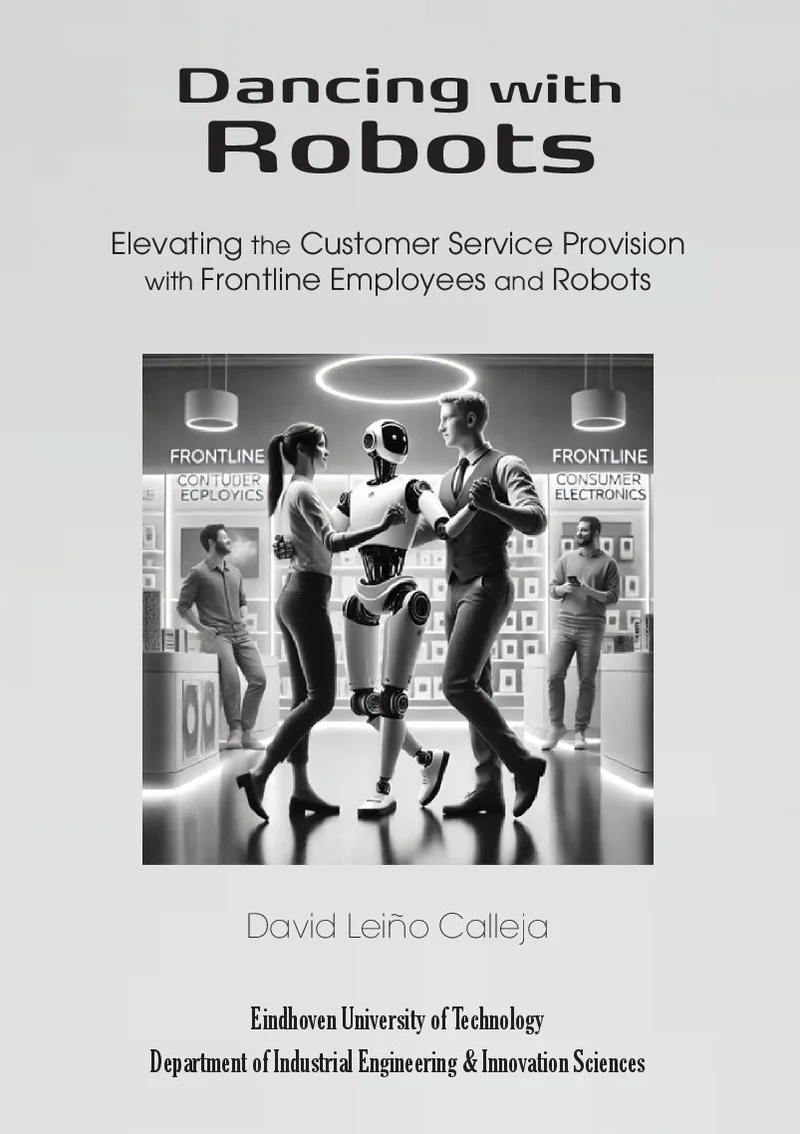
Share this project
Summary
To provide customers with an elevated (and/or more efficient) service provision, multiple firms have started to implement frontline robots (FLRs) in their customer-facing workforce. Nonetheless, managers and frontline employees (FLEs) are unsure about how to best employ such frontline service technology. Similarly, customers are not yet accustomed to FLRs and sense that firms could optimize such technology in their service interactions. This service triad (i.e., customer-FLE-FLR) requires deep exploration to better understand FLEs’ and customers’ evaluations of FLR-enabled service provisions. Notwithstanding, the literature to date is rather premature and limited given the novelty of the technology per se. Thus, scholarly efforts have yet to properly depict how FLRs shall act alone or together with FLEs to ameliorate customers’ perceptions of the service provision and the involved service agents.
In the first manuscript, “Some Agents are more Similar than Others: Customer Orientation of Frontline Robots and Employees”, my co-authors and I investigate the impact of FLRs on customer orientation perceptions. This is remarkable because customers may associate FLRs with standardization and cost-cutting, such that they may not fit firms that aim to be customer oriented. In four scenario-based online experiments and one online survey (N = 1,136), we collect data from customers interacting with FLEs and FLRs in different settings. We find out that FLEs are perceived as more customer-oriented than FLRs due to higher competence and warmth evaluations. Besides, we unveil that a relational interaction style attenuates the difference in perceived competence between FLRs and FLEs. Furthermore, we show that both service agents are perceived as more similar in competence and warmth when FLRs participate in the customer journey’s information and negotiation stages. Ultimately, we point out that switching from FLE to FLR in the journey harms FLR evaluations.
In the second manuscript, “Hybrid Human-Robot Teams in the Frontline: Automated Social Presence and the Role of Corrective Interrogation”, my co-authors and I elucidate how the type of robot (low- vs. high-ASP) influences customers’ perceptions of employees in a hybrid team as well as employees’ perceptions of the hybrid teamwork quality. This is noteworthy because the given hybrid team constellation might either strengthen or weaken the organizational frontline and the derived customers’ perceptions, depending on the distribution of roles and displayed behaviors. Using 4 video-based experimental studies capturing the customer’s view and 1 field survey tapping the employee’s view on hybrid teams (total N = 1,239), we find evidence that FLRs with a high-ASP improve customers’ perceptions of teamwork quality and, thereby, FLEs’ competence and warmth. The process is one of moderated mediation with both the FLEs’ and FLRs’ corrective interrogation as a central contingency. However, in the FLEs’ view corrective interrogations diminish rather than enhance ASP’s effect on teamwork quality.
In the third manuscript, “Recommend Your Competitor: The Effects of Agnostic Recommender Agents on Customer Trust and Business Performance”, my co-authors and I illuminate how RA agnosticism affects firm’s customer orientation perceptions and business performance. This is notable because customers may neglect RAs’ agnosticism when interacting with certain types of firms and frontlines, diminishing its power to effectively influence customers perceptions and behaviors. Utilizing 1 exploratory meta-analysis (n = 19), 2 scenario-based online experiments (n = 507) and 1 field survey within a B2B setting (n = 87), we find that optimal effects of RA agnosticism on trust in RA are achieved by firms which (i) hold customer-serving motives and (ii) do not integrate overly present FLEs in their frontlines. Besides, we disclose how (i) the derived firm’s customer orientation positively impact reputational (i.e., brand value) and attitudinal (i.e., intention to repurchase and synergetic sales) customer elicitations, and (ii) RA agnosticism has an indirect effect on these reputational and attitudinal customer elicitations through trust in the RA and firm’s customer orientation perceptions.
Protected: Maxim Hoekmeijer Test