Maxim Hoekmeijer Test
Beyond diagnostic boundaries
27 juni 2025
Protected: Maxim Hoekmeijer Test
Rijksuniversiteit Groningen
Open Ebook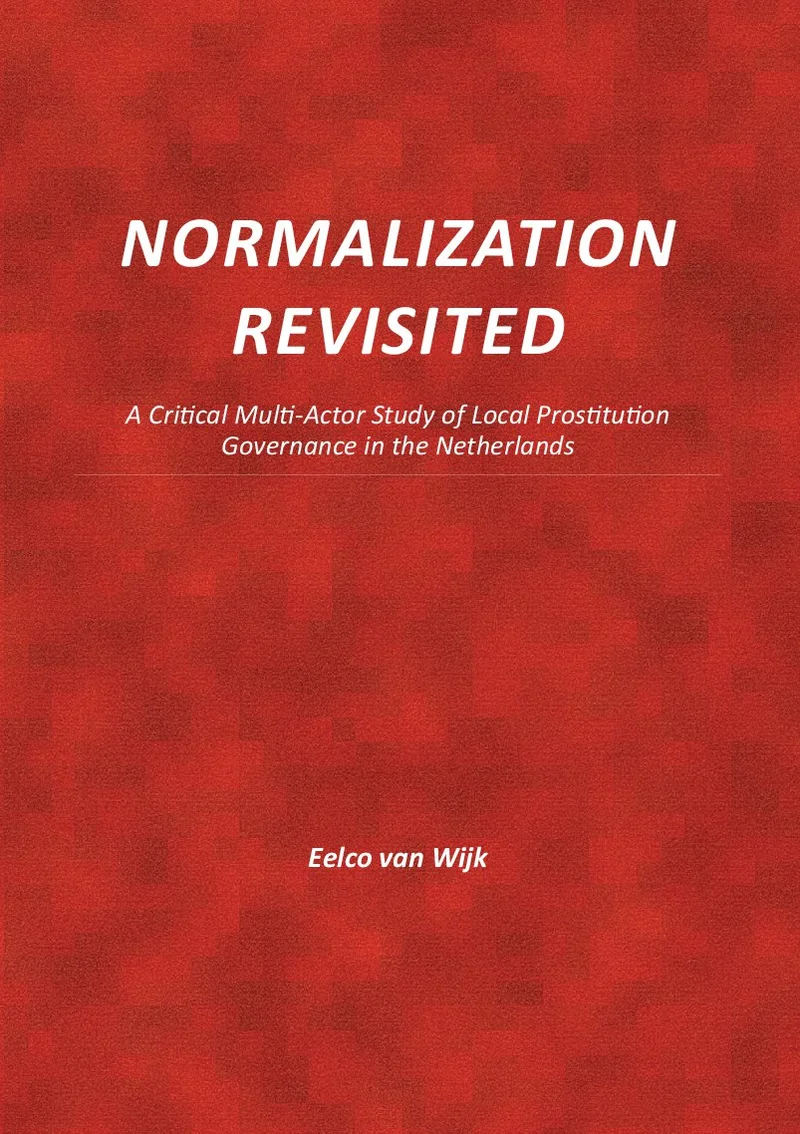
Share this project
Summary
Normalization Revisited
The Dutch approach to the governance of prostitution has long been associated with regulation, permissiveness, tolerance, and normalization. This ultimately culminated in the year 2000 with the lifting of the brothel ban, which became popularly known as the legalization of prostitution. However, many scholars and commentators have argued that the Dutch approach to prostitution has undergone a repressive shift since the early 2000s, with a greater emphasis on strict control and surveillance. While national legislation initially sought a balance between normalization and crime prevention, local municipalities, which were given primary responsibility for implementation, have essentially reformulated prostitution as a problem of trafficking and exploitation. This shift has accompanied an increasing drive toward regulation, surveillance, and punitive mechanisms.
This dissertation explores the evolving governance of prostitution in the Netherlands, focusing on the interplay between normalizing and abnormalizing discourses in local policy and practice. By examining how prostitution is “thought into existence” as a governmental issue in the city of The Hague, this dissertation demonstrates that what appears as a shift is better understood as a reconfiguration or deepening of normalization itself. Rather than a paradigmatic rupture, the incorporation of abnormalizing discourses into normalization has served to reinforce the underlying governmental rationality of creating a properly functioning prostitution market.
This argument is developed through a qualitative case study of The Hague, chosen both for its empirical typicality and theoretical utility. As a city with a representative variety of prostitution types and a historically normalization-oriented policy framework, The Hague provides fertile ground for examining the tensions, continuities, and contradictions within the local governance of prostitution. Central to the analysis is a Foucauldian governmentality framework, which enables a focus not merely on repressive state interventions but on the rationalities, discourses, and practices through which power is exercised and subjectivities are constituted. In contrast to conventional analyses that rely on binary conceptions of power, this dissertation adopts a more distributed, relational, and productive understanding of power, focusing on how discourses and practices co-constitute both the objects and subjects of governance.
Empirically, the study draws on thirty-nine semi-structured interviews with key actors involved in the local governance of prostitution, including municipal officials, police officers, welfare workers, prostitution business owners and managers, clients, and a limited number of sex workers and accountants. These are complemented by document analysis (policy documents, organizational mission statements) and online ethnography (specifically, 1,311 posts from a client forum thread). Methodologically, the research departs from traditional textual governmentality studies but then extends it by integrating interviews and policy implementation practices into its analysis, thereby expanding the methodological toolkit available to poststructuralist and Foucauldian research.
The findings are presented across three thematic chapters, each focusing on a specific group of actors that often remain understudied in prostitution scholarship: (1) municipal authorities, welfare organizations, and police; (2) entrepreneurs of prostitution businesses; and (3) clients of sex workers. Each chapter contributes to the overarching question: How does the interplay between normalizing and abnormalizing discourses play out at the decentralized level, both in local policy and in the various involved practices and actors, and what does that tell us about how prostitution is ‘thought into existence’ as a governmental issue?
The first empirical chapter demonstrates how The Hague’s municipal policy incorporates normalizing and abnormalizing discourses. While formal rhetoric emphasizes normalization, this is indeed intertwined with concerns about crime, exploitation, and human trafficking. Programs such as sex worker exit-programs and policing home-based prostitution appear at first glance to stem from abnormalizing logics. However, the analysis shows that in practice, these programs are co-produced through existing normalizing frameworks and organizational routines. Welfare organizations and the police embed these programs within their own logics of care and professionalism. Rather than representing a rupture, abnormalizing elements are folded into an ongoing normalization project aimed at constructing a safer, more manageable, and more governable prostitution market. This is accompanied by the municipality’s desire for “complete visibility” of the sector. This reflects a governmental rationality in which making prostitution legible to the state is a prerequisite for both its regulation and normalization, and a key aspect of its approach to normalization. Significantly, this visibility imperative does not extend to clients, who largely escape the ever-expanding governmental gaze.
The second analytical chapter focuses on the entrepreneurs of licensed prostitution businesses. It explores how these actors are “thought into existence” within municipal governance and how they are responsibilized as regulatory intermediaries. Entrepreneurs are positioned simultaneously as partners in normalization and as potential risks to public order. This duality is expressed in the policy mechanism of licensing, which both grants legitimacy and imposes a heavy administrative and regulatory burden. Entrepreneurs are expected to ensure safe working conditions, prevent exploitation, and monitor the activities of sex workers and clients. Through this responsibilization, they become nodes of governance—acting on behalf of the state while also being subjected to its control. The study finds that this responsibilization strategy not only shifts the locus of regulation from public to private actors but also transforms the power dynamics within the sector. Entrepreneurs become acutely aware of their precarious position: Failure to comply with municipal authorities’ expectations can result in the loss of their licenses. This dynamic fosters self-regulation and surveillance within businesses and contributes to the professionalization of the sector. However, it also creates monopolistic tendencies, particularly in sectors like window prostitution, and reduces sex workers’ autonomy by increasing managerial oversight.
The third analytical chapter turns to clients, an actor group typically overlooked in policy and scholarly analyses. Through interviews and online content analysis, the chapter examines how clients understand prostitution and their roles within it. Clients navigate multiple, often conflicting discourses—including those of sexuality, intimacy, market logic, and criminal risk—to construct their subjectivities. They understand themselves as ordinary citizens with legitimate sexual needs, as responsible consumers wary of exploitation, and as marginalized actors operating within a stigmatized yet functional market. Interestingly, clients engage in a form of collective self-governance. Online forums function as sites for the production and dissemination of normative frameworks: what constitutes a “safe” transaction, how to identify exploitation, and how to act as a “responsible” client. This discursive labor aligns with municipal normalization goals and enables clients to position themselves as participants in a regulated and morally justifiable market. Despite their relative invisibility in formal policy, clients thus actively contribute to the governance of prostitution and reinforce the character of normalization through market mechanisms through their own practices.
The findings from the three chapters coalesce into a central conclusion: the governance of prostitution in The Hague is not best understood as having shifted from normalization to abnormalization, but rather as a continuation and intensification of normalization itself. Abnormalizing discourses around crime and trafficking are not external challenges to normalization; they are operationalized within it. They serve to bolster the legitimacy of regulation, justify increased surveillance and responsibilization, and most crucially reinforce the market logic underpinning Dutch prostitution policy. This dynamic is particularly evident in how various actors—municipal authorities, entrepreneurs, welfare workers, and clients—engage in practices that contribute to the construction and reproduction of a “well-functioning” prostitution market.
Conceptually, the dissertation contributes to the field of public administration by integrating Foucauldian perspectives into governance analysis. It demonstrates how power is exercised not merely through repression or formal authority, but through dispersed networks of actors, rationalities, and practices. It also contributes to governmentality studies by emphasizing actors’ agency within governing assemblages. Rather than treating individuals as passive policy recipients, the study highlights their active role in shaping, translating, and sometimes resisting governmental rationalities. This is particularly evident in how welfare workers adapt exit programs, how entrepreneurs negotiate regulatory expectations, and how clients construct self-governing identities.
Furthermore, methodologically, the dissertation expands the governmentality approach beyond textual analysis by incorporating interviews, observations, and online ethnography. This mixed-methods strategy enables a more grounded and situated understanding of how discourses and rationalities are enacted in practice. It also opens up new avenues for analyzing how governmental power operates across different sites and scales.
The dissertation concludes by reflecting on its limitations and suggesting directions for future research. Most notably, it acknowledges the limited role of sex workers themselves in the empirical material—a consequence of practical constraints but also an area ripe for further inquiry. Future research could replicate the analysis conducted on clients with sex workers, examining how they conceptualize prostitution and their own subjectivities within a governance framework increasingly shaped by normalization and responsibilization.
In sum, this dissertation offers a critical reappraisal of Dutch prostitution governance. It shows that normalization, far from being eclipsed by repression, has expanded to incorporate abnormalizing discourses in ways that reinforce its own logic. Prostitution is governed not through a binary of normalization versus abnormalization, but through a dynamic, recursive process in which governance is simultaneously enabling and restrictive, productive, and repressive. This dual character reflects the complexities of governing morally contested domains in contemporary societies and underscores the need for nuanced, empirically grounded, and theoretically informed analyses of public policy.
Protected: Maxim Hoekmeijer Test