
Maxim Hoekmeijer Test
Beyond diagnostic boundaries
27 juni 2025
Protected: Maxim Hoekmeijer Test
Rijksuniversiteit Groningen
Open Ebook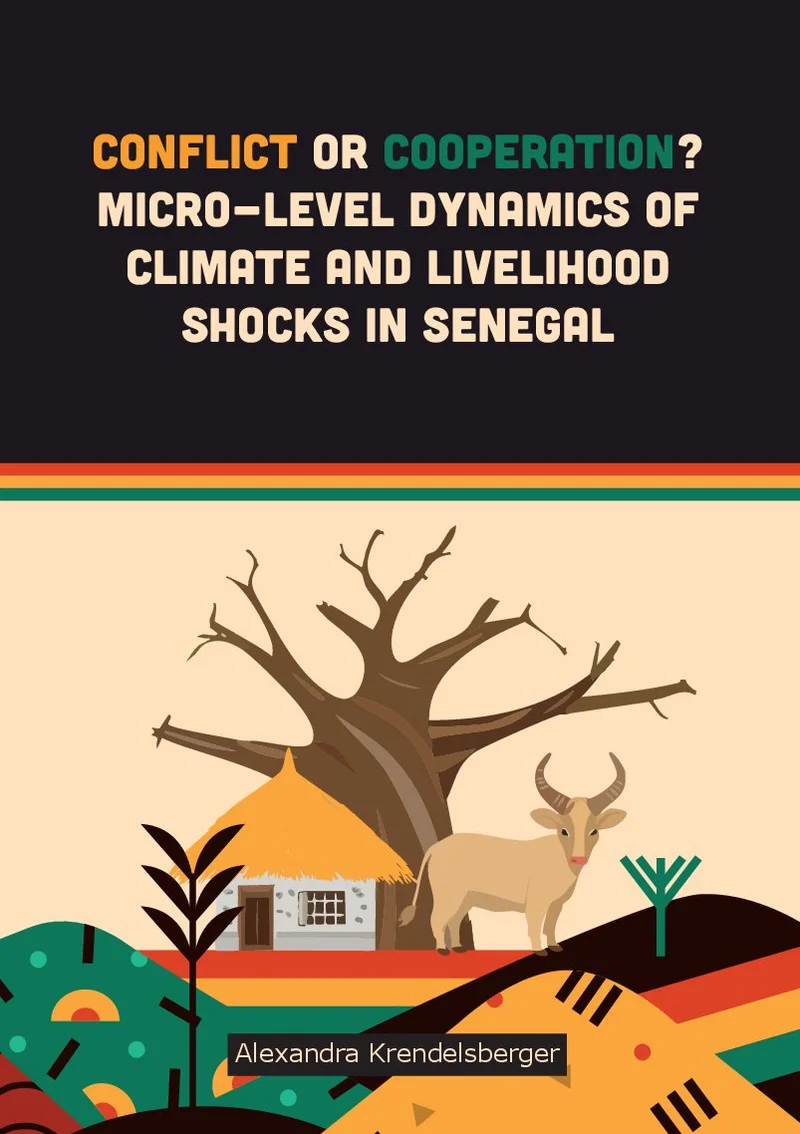
Share this project
Summary
As climate change and conflict are increasingly portrayed as co-occurring phenomena, attention is directed towards understanding potential underlying relationships. This thesis contributes to this effort by providing insights for better understanding the micro-dynamics of interactions between climate and livelihood shocks, conflict, and cooperation among individuals and groups.
In Chapter 1, a new conceptual framework is proposed and serves as an alternative explanatory model to mainstream theoretical frameworks, which have been unable to incorporate contemporary findings. The conceptual framework is validated through a set of research questions tested in four empirical studies presented in Chapters 2 to 5. This thesis takes farmer-herder interactions in Senegal as a case study and employs a mixed-methods approach in its research design.
Chapter 2 addresses the question: What are the fundamental aspects of understanding interactions between farmers and herders, and what role, if any, does climate change play in these interactions? This question is investigated by studying farmer-herder interactions in a context that remains relatively unaffected by politicized views surrounding conflicts between these two groups such as in Senegal. Methods used in this study include interviews, surveys, and focus-group discussions conducted throughout 2022. The results show that in a peaceful context such as Senegal, key factors influencing the outcomes of farmer-herder interactions are seasonal and geographic patterns, local conflict governance systems, natural resource management, and climate change. To better understand the current state of farmer-herder conflicts in a setting, this study recommends monitoring the aforementioned factors. Climate change has been found to affect daily farming and pastoral livelihoods in the case study areas, but no direct causal link between climate change and farmer-herder conflicts has been established. More important are spatial and temporal changes, conflict governance systems, and natural resource management. While climate change holds secondary relevance, climate or other livelihood shocks potentially create disruptive effects due to their unpredictable nature, which is investigated in the subsequent chapter.
Chapter 3 examines the question: How do collective shocks, compared to individual shocks, affect intra-community cooperation within farming and pastoral groups in their distinct contexts? A public goods experiment is conducted with 424 farmers and pastoralists in two distinct agro-ecological zones in Senegal. This study finds that collective shocks reduce, and individual shocks increase, cooperation, explained through mechanisms of risk aversion and risk-sharing, respectively. Pastoralists react more strongly than farmers, who appear less responsive to the different types of shocks. This suggests that social and geographic context significantly alter decision-making under the same experimental conditions. Generally, pastoralists behave more cooperatively than farmers on average, which is attributed to weaker market integration and stronger reliance on social and trading networks due to geographic dispersion. As extreme climate events act as collective shocks, these findings suggest that cooperation among community members—especially among pastoral groups—may break down. However, high overall levels of cooperation among pastoralists indicate they are receptive to the provision of public goods and services, offering a potential entry point for climate adaptation and development efforts. The main conclusion is that collective shocks can be destructive to intra-community cooperation, while inter-group dynamics may also be triggered, warranting deeper investigation in the next chapter.
Chapter 4 explores the question: how do in-group and out-group perceptions affect inter-group cooperation between farmers and herders, and how are these perceptions influenced by collective risks? A public goods experiment with in-group and out-group priming messages is used, coupled with focus group discussions before and after the experiment. The study finds that for farmers, cooperation with out-group members is generally lower than with in-group members. Herders, however, not only reduce cooperation with farmers but also with other herders, due to rivalry between local and mobile herders over contested water and pasture resources. Out-group hostility towards herders is strongly influenced by negative stereotypes about mobile (transhumant) herders, who are perceived as untrustworthy und disrespectful strangers by both farming and pastoral communities. When collective risks are introduced, the in-group-out-group bias intensifies compared to when individual risks are present. This has significant implications for conflict research, as it suggests that climate and livelihood shocks strengthen in-group favoritism and out-group hostility. Even in a relatively peaceful region like Senegal, addressing negative stereotypes about transhumant pastoralists is crucial for preventing conflict escalation. Further investigation is needed to understand how conflict and cooperation respond differently to collective shocks arising from climate variability, which is addressed in the next chapter.
Chapter 5 focuses on the question: how is climate variability associated with conflict and cooperation outcomes in Senegal, and to what extent does an agricultural channel mediate these relationships? A panel econometric analysis is conducted for the period 2002–2017 on a 0.1 grid-cell level, combining climate, agricultural, conflict, and cooperation data. The study finds that wetter-than-usual conditions increase both crime and community participation in the same year. Similarly, hotter-than-usual temperatures in the previous year are positively associated with the same indicators. These relationships are only weakly supported by the presumed agricultural mechanism. Overall, the findings suggest a new direction for climate-conflict research, indicating that conflict and cooperation are likely to co-occur and respond similarly to climate variability, contrary to the common assumption that they move in opposite directions. The complexity of disentangling these mechanisms becomes evident, especially when analysis is limited to one country. Conflict and cooperation appear to naturally co-exist, with cooperation potentially serving as a response to conflict. This raises a new question: What is the relationship between conflict and cooperation, and what mechanisms explain their associations with climate variability?
Chapter 6 addresses the question: How are climate impacts and livelihood shocks translated into lower-order group conflict and cooperation on a micro-level? The outcome depends on the state of livelihood resilience, the nature of the shock, the social and geographic context, stereotypes, group identities, traditional conflict mediation structures, and alternative livelihood opportunities. Based on this conclusion, a set of indicators for monitoring farmer-herder relations is proposed to identify early warning signs before interactions escalate into violent conflict. This thesis advocates for the use of mixed-methods approaches, discusses their strengths and limitations, and outlines the overall limitations of the thesis and avenues for future research. More broadly, it calls for a shift in research focus—from climate-conflict relationships toward climate-cooperation dynamics.
Protected: Maxim Hoekmeijer Test