
Maxim Hoekmeijer Test
Beyond diagnostic boundaries
27 juni 2025
Protected: Maxim Hoekmeijer Test
Rijksuniversiteit Groningen
Open Ebook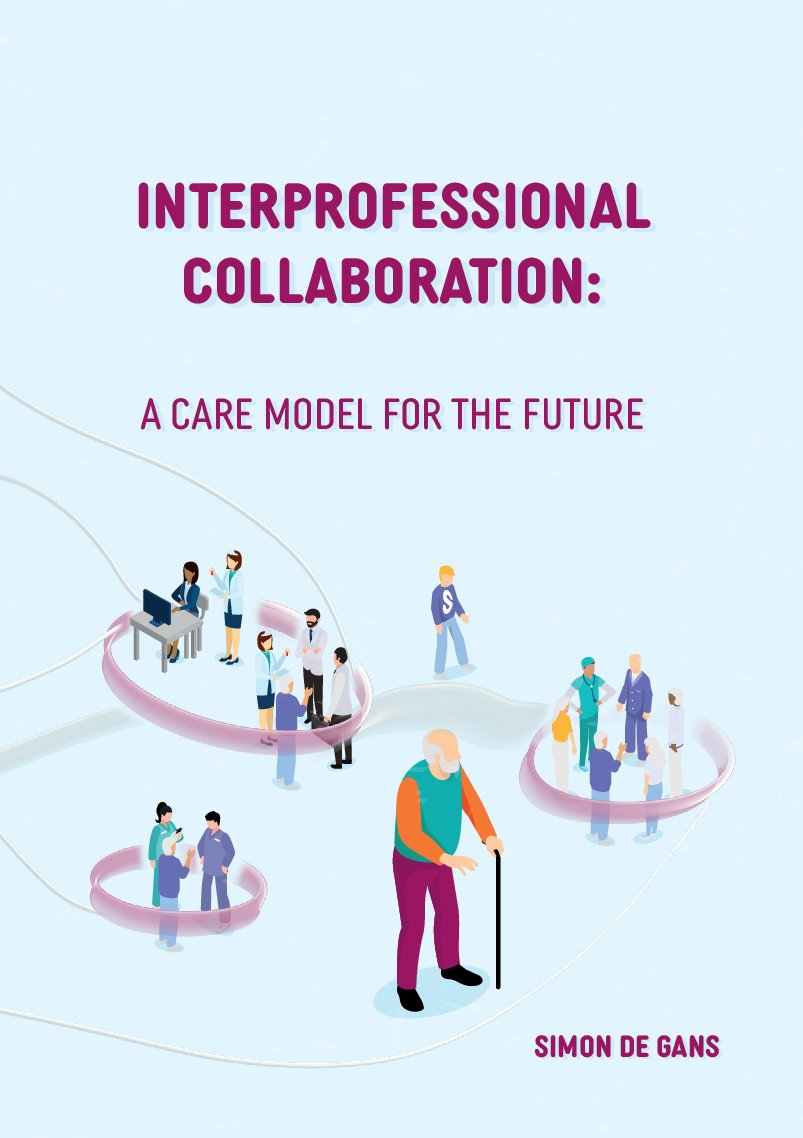
Share this project
Summary
People are living longer, and multimorbidity (having multiple conditions) is becoming more common. This leads to increased healthcare utilization, higher costs, and a shortage of healthcare workers. In the current organization of care, medical specialists primarily look at their own field or organ. Consequently, older multimorbid patients are at risk of care fragmentation, leading to poorer health outcomes. This puts healthcare under significant pressure in the coming years, making the need for collaboration higher than ever.
The Jeroen Bosch Hospital (JBZ) recognized the need to improve care and was convinced that the JBZ could enhance care for older patients with multimorbidity. To this end, the JBZ established the Intensive Collaboration Ward (ICW), where cardiology, geriatrics, internal medicine, pulmonary medicine, and hospital medicine work together interprofessionally with nurses and paramedics to provide the highest possible quality of care.
The aim of this thesis was to investigate whether the quality of care for older patients with multimorbidity was truly improved by the ICW. The quality of care can be divided into five categories according to the Quintuple Aim:
1. Better patient experience of care
2. Better health outcomes
3. Lower costs
4. Improved healthcare professional wellbeing
5. Better use of people and resources
This thesis is structured according to the Quintuple Aim, with all these aspects being investigated.
Part 1 examines patient satisfaction. Chapter 2 looked at the first 3 categories of the Quintuple Aim. Outcomes were collected from 200 patients treated on the ICW and 51 comparable patients treated on regular wards (control group). This study demonstrated high patient satisfaction on the ICW, with a score of 8.22 out of 10. Additionally, ICW patients had better health outcomes, such as a shorter length of stay (-2 days) and fewer medical consultations on the ward (-49%). An overview of the costs and benefits of the ICW was provided, but whether this leads to cost-effectiveness requires further research. This research was conducted in Part 3 in Chapter 5.
Part 2 examines the health outcomes of patients. In Chapter 3, we examined whether patient health outcomes improved through interprofessional collaboration on the ICW. This mostly looked at the same outcomes as in Chapter 2, but used a different group of control patients to obtain more robust results for certain outcomes. ICW patients required fewer medical consultations on the ward and in the ER (-69% and -14%, respectively) and received more paramedical care (+23%). These results provide more evidence for the positive effects of interprofessional collaboration for older patients with multimorbidity.
In Chapter 4, we collected follow-up data from the patients in Chapters 2 and 3. These data show that patients treated on the ICW were less likely to end up in the ER (-61%) and required fewer outpatient visits (-51%) in the six months after discharge.
In Part 3, we looked at the cost of care. In Chapter 5, an economic evaluation was conducted to assess whether the ICW leads to lower costs, the third category of the Quintuple Aim. The ICW led to better health outcomes, which reduces costs, but there was also more staff deployment on the ICW, which increased costs. All factors together showed that the ICW is cost-neutral. The ICW is potentially cost-effective when looking at outcomes, but a more generic outcome measure such as quality of life is needed to substantiate this claim. The ICW did not lead to lower costs but nevertheless provided better health outcomes at the same cost. In this study, we also looked at the deployment of people and resources, the fifth category of the Quintuple Aim. The ICW can improve this by freeing up beds, reducing workload for staff, and requiring fewer staff. This improved use of resources is important given current and future staff shortages.
In Part 4, we looked at the wellbeing of employees. In Chapter 6, we implemented the ICW in another hospital in the Netherlands. The goal was to investigate employee wellbeing, the fourth category of the Quintuple Aim. We examined whether different concepts of employee wellbeing are related and whether scores on these concepts changed over time during interprofessional collaboration. We showed that the concepts 'work engagement' and 'culture of care' (r 0.48) and the concepts 'culture of care' and 'interprofessional identity' (r 0.30) are related. Employee wellbeing did not change over time during interprofessional collaboration. This last result is less reliable given that the implementation of the ICW was only partially successful. New studies should investigate whether employee wellbeing changes due to interprofessional collaboration.
In Chapter 7, we investigated how employees interact with each other in different types of patient meetings. For this, we made video and audio recordings of multidisciplinary and interprofessional patient meetings. We concluded that several factors influence employee behavior at the level of participation, learning, and patient-centered care. We formulated nine important strategies to optimize collaboration. Additionally, we observed 5 employees who participated in both types of patient meetings, and they showed completely different behavior. This underscores the influence of the identified factors and strategies on employee behavior during patient meetings.
In Part 5, we looked at the deployment of people and resources. In Chapter 8, the learning effect of interprofessional collaboration was investigated. It was hypothesized that professionals learn with, from, and about each other during collaboration, without needing an educational intervention, and subsequently apply this increased knowledge on their own ward. The highest possible outcome of learning is that it actually changes patient health outcomes. Therefore, we investigated whether the number of medical and paramedical consultations changed on the regular wards of the specialties involved in the ICW. We showed a significant decrease of 16.9-19.3% in medical consultations and an increase of 9.4-20% in paramedical consultations. These outcomes suggest that professionals experienced a substantial learning effect from working interprofessionally on the ICW, which ensures increased quality of patient care.
In Chapter 9, we conducted a scoping review of facilitators and barriers to interprofessional collaboration. Many studies investigated which factors influence the success of interprofessional collaboration, which relates to the deployment of people and resources, the fifth category of the Quintuple Aim. Our scoping review included 52 studies, of which 43 described facilitators and 46 described barriers. Most factors were complementary (e.g., familiarity as a facilitator, lack of familiarity as a barrier). Important factors for effective interprofessional collaboration include: achieving a common goal; facilitating an interprofessional identity; reducing dysfunctional hierarchies; reducing medical dominance; and overcoming personal differences such as gender and race. This scoping review provides a comprehensive overview of facilitators and barriers to interprofessional collaboration, which must be taken into account when designing interprofessional collaboration.
Finally, Chapter 10 provides a summary and discussion of all studies, placing this thesis in perspective relative to clinical practice and the future of healthcare.
The findings of all these chapters show that interprofessional collaboration on the ICW scores well on all 5 categories of the Quintuple Aim. This suggests that the ICW can be a promising reform for healthcare to address the current and future challenges of caring for older patients with multimorbidity.
Protected: Maxim Hoekmeijer Test