
Maxim Hoekmeijer Test
Beyond diagnostic boundaries
27 juni 2025
Protected: Maxim Hoekmeijer Test
Rijksuniversiteit Groningen
Open Ebook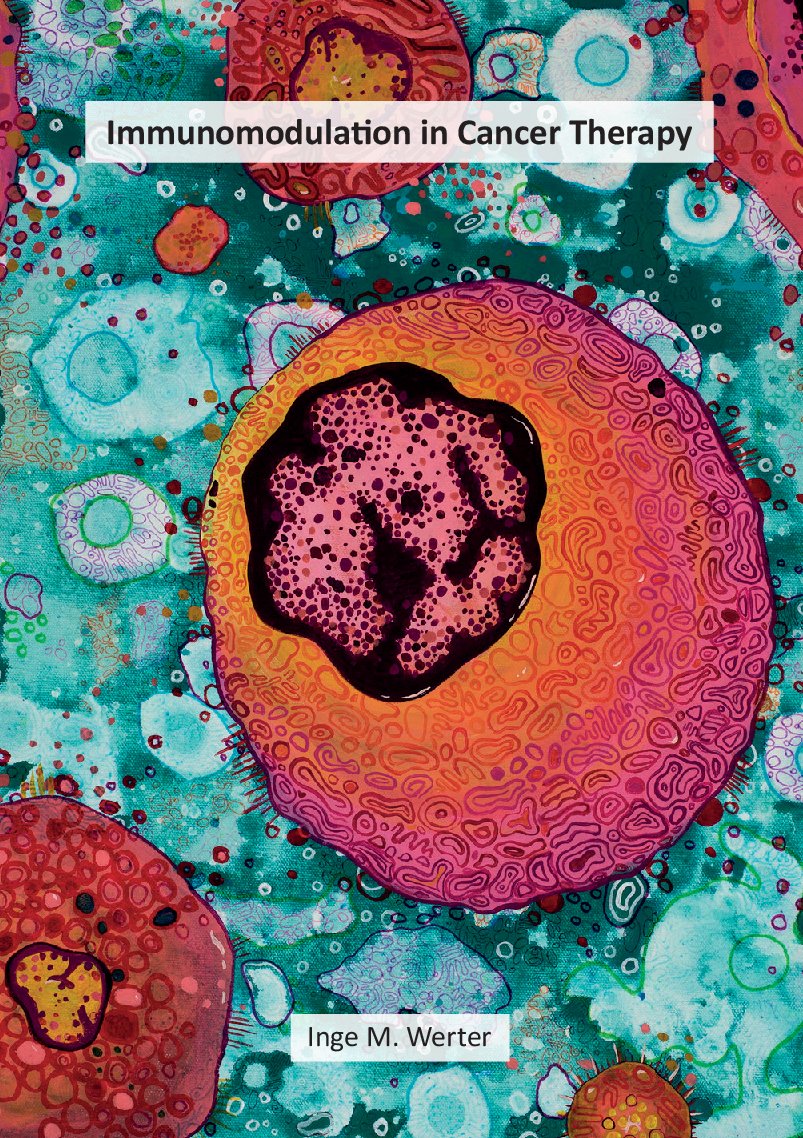
Share this project
Summary
The main focus of the research described in this thesis lies on immunomodulation in cancer therapy. Much has changed in the landscape of cancer treatment since the National Cancer Act of 1971. Cancer therapy modalities include surgery, radiation, chemotherapy, hormonal therapy, targeted therapy, immunotherapy, and antibody-drug conjugates (ADCs). Despite progress, there remains a significant need for further research as many patients still succumb to the disease. In the immunotherapeutic era, various ways to improve immune system functionality have been studied, using the Cancer-Immunity Cycle (CIC) as a framework.
The CIC consists of sequential critical steps: 1) release of cancer antigens, 2) antigen presentation, 3) priming and activation in secondary lymphoid organs, 4) transport of T cells to tumors, 5) infiltration of T cells into tumors, 6) recognition of cancer cells by T cells, and 7) killing of cancer cells. Immunomodulation aims to overcome blockades in this cycle. This thesis describes therapeutic strategies for breast cancer (BC) and metastatic renal cell carcinoma (mRCC).
Chemotherapy, radiation, ADCs, and targeted therapies can induce tumor cell apoptosis, leading to antigen release (Step 1). The ADC Trastuzumab-Deruxtecan (T-Dxd) specifically targets Her2+ cells, resulting in selective cell death and subsequent T cell response. Chapter 5 shows that T-Dxd is a highly effective treatment for Her2+ metastatic BC with brain metastases (BM). BM are challenging due to the blood-brain barrier (BBB) and immune evasion mechanisms, but T-Dxd demonstrated significant objective response rates.
In the Phase 3 Spinoza study (Chapter 4), we attempted to stimulate dendritic cells (DCs) in patients with locally advanced BC (LABC) by adding the growth factor GM-CSF to neoadjuvant chemotherapy (NAC). BC is generally an immune-excluded tumor type. GM-CSF was found to be more potent than G-CSF in stimulating DC maturation in tumor-draining lymph nodes, potentially creating a more robust anti-tumor immune response.
For mRCC, we investigated improving the standard second-line treatment, everolimus. Everolimus can lead to an undesirable expansion of immunosuppressive regulatory T cells (Tregs). In Chapters 2 and 3, we explored counteracting this expansion using metronomic cyclophosphamide. While a daily dose of 50mg cyclophosphamide successfully reduced Treg levels in peripheral blood, this did not translate into improved progression-free survival (PFS) in the Phase 2 trial, likely because the reduction was not sustained or sufficient to achieve effective anti-tumor immunity.
The therapeutic strategies described in this thesis impact various steps of the CIC. Understanding these effects at an immunological level is crucial for developing more effective therapies. We believe that future clinical trials should incorporate translational analyses based on immunotypes and the CIC framework to better treat patients with diverse immune profiles.
Protected: Maxim Hoekmeijer Test