Maxim Hoekmeijer Test
Beyond diagnostic boundaries
27 juni 2025
Protected: Maxim Hoekmeijer Test
Rijksuniversiteit Groningen
Open Ebook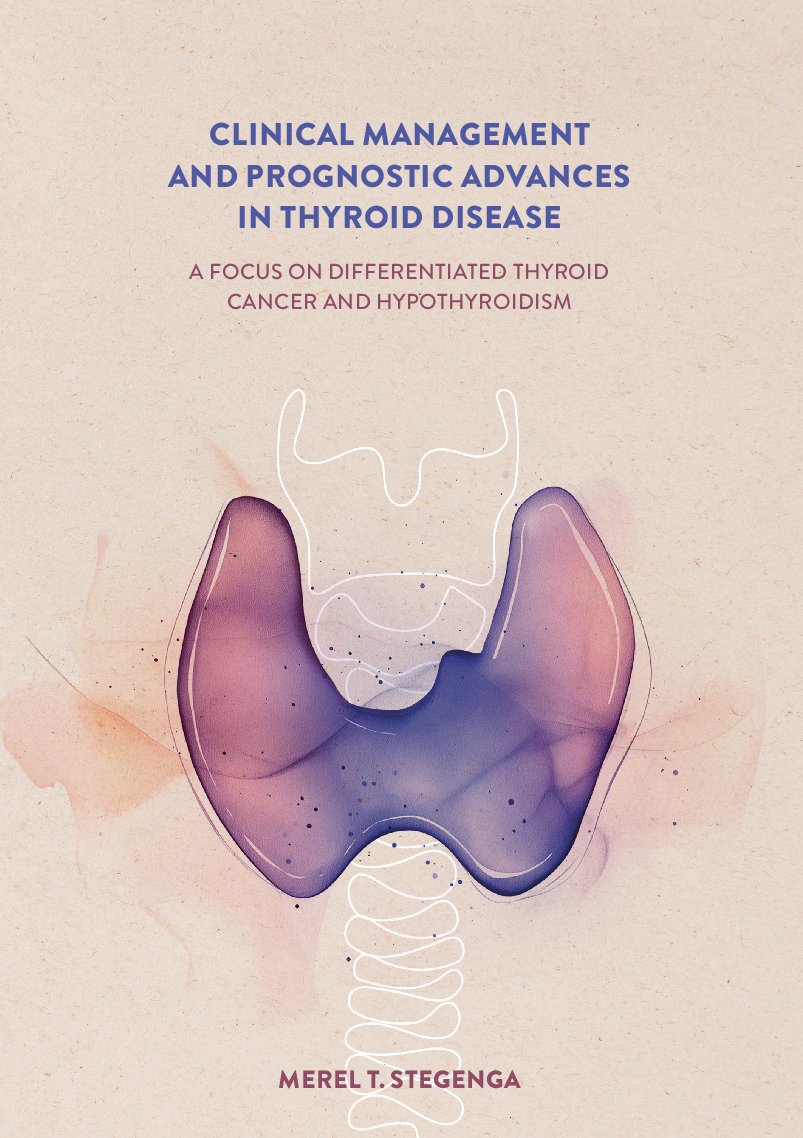
Share this project
Summary
This thesis presents clinical management and prognostic advances in thyroid disease, with a specific focus on differentiated thyroid cancer (DTC) and primary hypothyroidism. The overall goal is to improve clinical care by optimizing risk stratification for thyroid cancer and evaluating new treatment strategies for hypothyroid patients with persistent symptoms.
Chapter 2 focuses on the prognosis and risk of recurrence in DTC. We compared the 7th and 8th editions of the AJCC/UICC TNM staging system, showing that the 8th edition provides better survival prediction for both papillary (PTC) and follicular thyroid carcinoma (FTC). We also investigated the role of age as a continuous prognostic factor rather than a single cutoff at 55 years, finding a nearly linear association with mortality. Furthermore, we evaluated the performance of the 2015 ATA Risk Stratification system in high-risk patients and those with distant metastases, and assessed the impact of the 2022 WHO classification on the categorization of oncocytic and follicular thyroid carcinoma.
Chapter 3 explores the role of radioactive iodine (RAI) therapy. We compared different international guidelines to determine the indication for postoperative RAI and assessed the risk of missing distant metastases. We also identified clinical and histopathological risk factors for RAI-refractory disease in FTC and OTC patients, emphasizing the need for early identification of these high-risk individuals.
Chapter 4 presents the study protocol for the T3-4-Hypo Trial. This national, double-blind, randomized controlled trial investigates the efficacy of LT4/LT3 combination therapy compared to LT4 monotherapy in hypothyroid patients who have persistent complaints despite biochemical euthyroidism. The trial aims to provide a definitive answer on whether combination therapy improves quality of life and fatigue, while also looking at genetic markers (DIO2 and MCT10) and organ-specific effects on the brain, heart, and bones.
In conclusion, this thesis contributes to more personalized management of thyroid cancer through refined staging and risk assessment. Additionally, it addresses a long-standing clinical dilemma in hypothyroidism treatment by initiating a large-scale, robust clinical trial to improve the well-being of symptomatic patients.
Protected: Maxim Hoekmeijer Test